Assyrian Genocide Survivor: Rose Sargis (1914-2010)
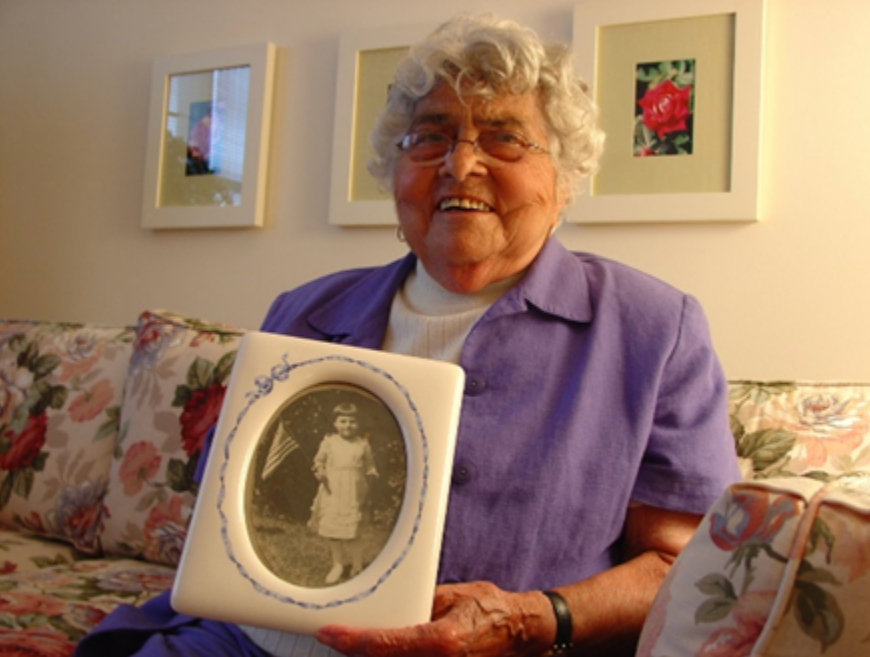
Rose Sargis (RS): I’m Rose Sargis. I was born in Iran in 1914. War had just begun.
Interviewer (Q): What village were you born in?
RS: Abajalu was the name of our town. From our town, as I understand, doctors were educated by the Presbyterian missionary people. They are the ones who put up schools for us and taught teachers, taught ministers and theologians and so on and so forth. But it’s 1914 and I was three months old
Q: What was your mom’s name?
RS: My mom’s name was Eslye, her maiden name was David, and her married name to my dad was Agase.
Q: And your father’s full name?
RS: Delazus (sp?) Agase… So anyway, we were in this barn with my – my mother was Armenian - with my mother’s Armenian family, hiding from the enemy. I, as a three-month-old
Q: Who were they hiding from?
RS: From the Kurds, or anyone else that was out there to kill anybody for no rhyme or reason. At the age of 3 months, I started crying. My uncle, my mother’s uncle, said to my mother, “Throw her into that river 'cause they’ll hear her cries and they’ll come and kill all of us.” And that was true. They would do that. They used to take people up against the barn and shoot them for no rhyme or reason. So anyways, this was 1914, at the age of 3 months, then the war subsided for…a short while. We went back to our homes for a while. Then, again, it began in 1917 – it ended in 1917, it started again earlier. We were thrown out of our homes, ransacked, and were fleeing on foot.
Q- How old were you then?
RS: I was by then 4 years old. My mother told me that I was 4 years old. We were barefooted, with no food, nothing really, just the clothes on our backs, and we were fleeing, not knowing where we were going, not knowing what would become of us. And then suddenly - I remember this myself at the age of 4 - the British army came and rescued us and took us to Iraq, and put up tents for us, and fed us, and clothed us until my father found where we were after the war. Because, as you all know, after the war, everybody’s scattered. My dad was here in Chicago…he was with the Carter Westminster church that helped my dad, with the Presbyterian missionaries, find where we were in Iraq being taken care of by the British army. Then he did send for us.
Q: Do you remember anybody from your village that were also there with you?
RS: Yes. Some friends were there with us…there was one I know that was a cousin to my husband. Walter Jacobs. And his mother.
Q: Do you remember her name?
RS: Her name was…I’m forgetting her name now, it’s been some time since I’ve used it. There were several people that we did know…While we were in camp, so to speak, my cousin had gone downtown in Iraq and bought each of us a rubber ball. There was one square area that was cemented like a sidewalk, and we were playing with our rubber ball, and all of a sudden about six high school kids – this was by the railroad tracks, and I remember right over the tracks were fields of poppy and my cousin said, ‘give me the ball because the boys will take it away from you.’ I said, ‘No, I’ll just put it behind my back.’
Well, before I knew it, one of those six high school kids came and grabbed it out of my hands. And the whole town that we’re in, the tents there, ran after those six boys trying to get that ball back. That’s how precious balls were in those days.
Q: This village, this was in Baquba, Iraq?
RS: Yeah, Baquba. They caught one of the boys and took a book away from him. I remember the next day – because books were precious in those days – the father and the son came begging for his book, and we gave it to him, but he said he didn’t know who took the ball. So to this day, I love balls, I always used to buy balls for kids. That was in Iraq, until my dad discovered through the Presbyterian Church missionaries and our Iranian missionaries where we had land, and my dad sent for us. That was 1921 that we came to America.
Q: Prior to coming to America in 1921, did your mom tell you any stories and did you remember any stories that the elders told you?
RS: As I was a kid, it took us three months, three different ships, to come here… We finally got to America on Canal Street, and we got a cab, and we came to these flights of stairs on Oak Street in Chicago, and we climbed these stairs, and there was my dad who had never seen me. I had never seen him, of course, and my aunt and my uncle. The first thing my uncle said to my mother because he had become a barber on Chicago Avenue, he said to her, “I have to cut her hair”, my mother started crying because people in Eastern countries, women don’t cut their hair, the girls don’t cut their hair. Anyway, he did cut my hair, and my mother wept like you wouldn’t believe. He told her the reason he was cutting it was because the children would not play with me. I have a picture of that haircut, with the American flag, which I love dearly, and I cherish it because it’s the only picture I have of myself as a young child of seven years old.
Q: Do you remember, if we go back to Urmia before you came here, do you remember anything about those marches, where you left from, the days of when you left Urmia?
RS: At the age of 4 – my mother used to [unclear] mention this, beg – because we had nothing – for food for me for 10 days they used to tell me. I remember seeing this, at 4 years old, fleeing, children that were left along the wayside. If a mother had more than one child, she could not have it. They would just sit them down on the ground, put some raisins on their lap, and carry on for their own lives. I remember that very distinctly. But beyond that, and being in Iraq those three years, and the things that helped, the British Army helped us to survive—another miracle.
…I don’t know whether I fulfilled what you wanted to hear because somehow I think I was a little young for all these times of war and haven’t been able to capture too much of it.
Q: It’s remembering as much as you can, and that’s all we hope for, that your stories reach the generations to come. This is why we’re here and we’re talking about this. Things of this nature need to be shown so these things don’t happen again in the future.