Elishwa’s Heroic Journey: The Exodus
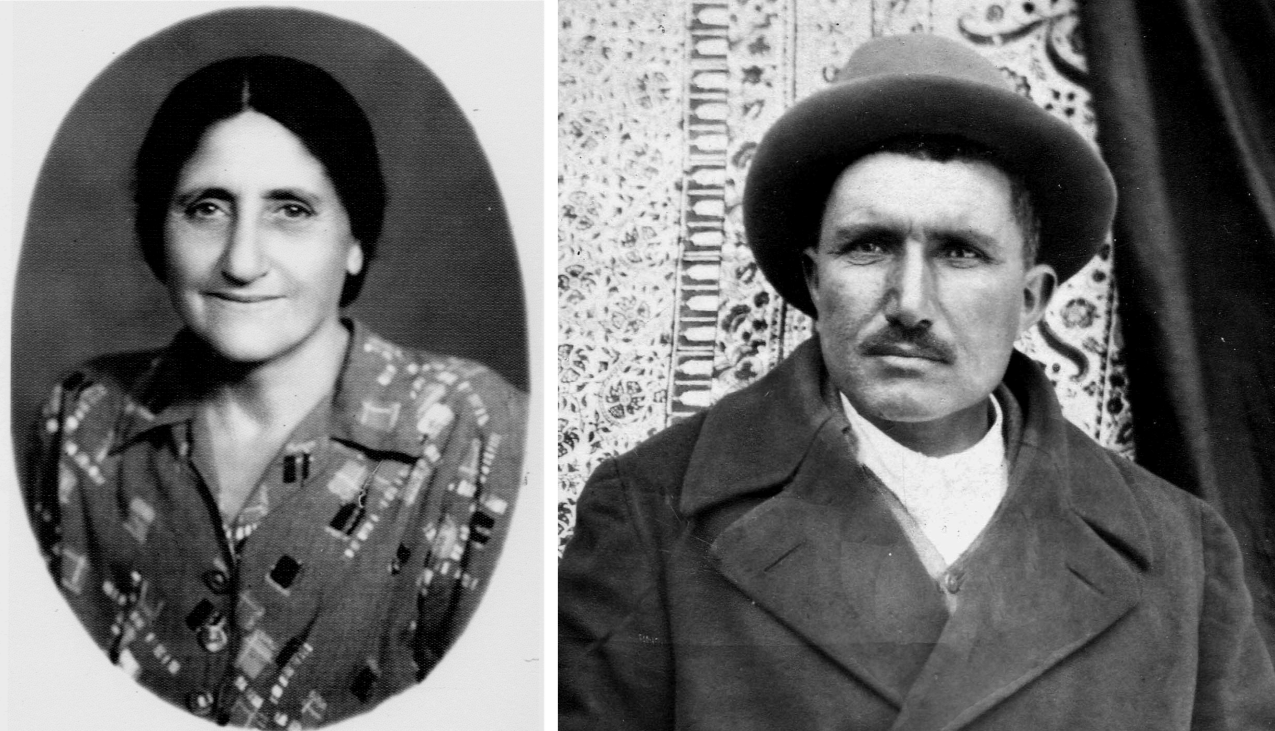
Elishwa, left, and her husband, Lazar, right
When the supplies from the British and the Russians dried out the Assyrian armed men retreated to their villages to protect their homes and families. The reaction from Kurds and Turks was so overwhelming that the armed Assyrians had to fight off attacks on their villages, and help their families flee south alongside the Iraq/Iran border. Lazar decided to join the Exodus with his brothers, sisters, and families. His two sisters went missing. Using his beloved white horse, he went looking for them. He found one but the youngest went missing as dead or kidnapped. Meanwhile, Elishwa, waiting for Lazar to join the family group in the Exodus, panicked and left her baby behind. The cries of the baby were too unbearable, so she returned, fetched the baby, and in more panic joined the family group. Lazar delivered one of his sisters to the fleeing group and returned to join the men who were protecting the rear of the Exodus.
Ten thousand Assyrians fled to Russia and sought safety, and never returned. Some 80,000 men, women, and children from Urmia, and mountaineers from northern Iraq joined the exodus led by Dr. William A. Shedd and a group of Assyrian leaders over 500 miles from Urmia to Hamadan in Iran, and then to Bequbah in Iraq. Lazar joined the resistance at the rear of this exodus, Elishwa, and baby son Michael separated from Lazar, and marched with her sisters, parents, and Lazar’s family members. Elishwa had one thing in mind and that was saving Michael. Lazar and Elishwa had the foresight to cater for a long haul and arranged to line up Elishwa’s waistcoat with gold coins that Lazar had saved. She wore the coat next to her skin. The 500 miles was a treacherous journey. Some mothers with more than one child had to leave any sick one behind to save the other (s). The 80,000 fleeing Assyrians used horse-driven carriages, horses, mules, and donkeys to flee with some bare necessities. Some fled on foot with their children and bare necessities. Besides the armed Assyrians at the rear of the exodus stalling the advance of attacking footmen and mounted Muslims, selected leaders administered the fleeing population to help them move in the right direction and along the best route possible leading them south where some British garrisons were located.
The weather was hot during the day and cold during the night; the terrain varied from plain, and arid to hilly, watery, and mountainous. Many died en route. Elishwa’s father, and brother were some of many. The route taken by the exodus was marked by dead bodies. During the exodus there were cries of children abandoned by their parents and hopeless women and children whose body was giving up and could not keep marching; help was not available from the Russians and the British even though the Assyrians were their allies in the battles with the Turkish army. The Russians did send 200 Kazaks back to Urmia, but they were slaughtered by the Turks and Kurds on their arrival. The Assyrian leaders did not have enough basic supplies to help, and therefore everyone had to fend for him/herself. Food was obtained along the way from any village, unaffected by the Muslim fanatics.
Water became very scarce in parts of the route. Any rainwater collected in the ground was used when necessary. There are tales of women drinking horse urine, mistaken for water, in the horse hoof marks. Kurds and Turkish mounted men from some villages along the column of the exodus attacked the fleeing crowds, stealing their possessions, and kidnapping young girls whose parents helplessly saw their daughters disappear, and never to see them again dead or alive
Elishwa, separated from Lazar, looked after her baby son Michael over the 500 miles of cruel track. Breastfeeding him and using every resource en route to keep her baby alive. The gold coins which lined her waistcoat came in handy at some friendly villages. This waistcoat became her savings bank over a long period. Lazar and all remaining fighting men were cut off from the exodus column for a long period. These men finally had to follow the exodus tracks. Dead bodies were clear markers of the route because 40,000 died on the route. Lazar, still riding his beloved horse, followed the track not knowing the fate of his young wife and all the other family members.
After six days the exodus arrived at a river where they rested, refreshed their supplies the best they could, and stayed overnight. But in the early hours of the morning under the pressure of approaching Kurds and Turks, the fleeing resumed. Some of the mountaineers herded their sheep amongst the fleeing crowds which created more congestion and dust in the heat of July. The sounds of the dying, wailing of women, and cries of children filled the air and induced more terror.
The survivors reached Saieen Kala where they met a small British garrison who was of some help with their limited supplies; a loaf of bread must have felt like manna from heaven. After a short respite, they had to flee again in a panic under the pressure of the attacking Turks and Kurds who were seen in the distance raising clouds of dust as they approached with their gleaming swords. The leaders with some help from the British garrison guided the survivors through difficult terrain through valleys surrounded by high mountains, and where there was no sign of much vegetation. The intense heat, Asiatic cholera, and dysentery claimed many lives enroute. A mother nursing her baby while leaning against a rock was seen by the surviving wife of a doctor. But on close examination, the mother was found to be dead, but the child was still nursing.
The terrorized fleeing crowds had no time to help each other. Elishwa clung to her baby son and used every resource to save him. The march continued over steep tracks and around the mountains until they reached BIJAR, a Kurdish town in Kermanshah, Iran. Bijar has lush and watery surroundings and is famous for its rugs. Fortunately, the British had a strong garrison in Bijar, and the town population was not affected by the fanatics of the attacking Kurds and Turks. Here the Assyrians felt much safer and camped in gardens and orchards made available by the British. The Assyrian Dr David Youhanan who attended to the sick of all nationalities fell ill and died in Bijar. He was buried on a hill with a tombstone provided by the British Captain Fisher at the pleading request of David‘s wife. Mrs. Youhanan had to leave Bijar with her three children and join the exodus to Hamadan, and from there she made her way to the USA and settled there. Her surviving son became a professor of English at New York University.
The survivors were led to Hamadan in Iran then to Baqubah northeast of Baghdad, Iraq where the British had a large presence. The British set up a refugee camp for all 40,000 surviving Assyrians, and a few thousand Armenians. Elishwa, her baby, and the surviving members of her family as well as Lazar’s family members settled in Bequbah Camp. By now, Elishwa, having lost her father and brother during the exodus, had three sisters and her mother left. Lazar had two brothers, one of whom, David, was married to an Armenian lady, Saroungul; they lost their three children en route to Baqubah. Saroungul was so heartbroken that she wore an incredibly sad face, and never smiled. David was as tall as Lazar with gentle manners. The other brother was Iskhak who was married to Ister and had six children, the oldest was Shawil who was killed by the German bombing of Habbaniya in 1941. Lazar’s sister Sarra was married to an Armenian man, Karow; they had no children. They all settled in the Baqubah refugee camp which was opened and funded by the British. For three months Elishwa, without her husband, shared a tent with her immediate family in a terror-free environment but a far cry from their home in Urmia, the Persian Paradise. She had no idea what her husband’s fate was. She kept nursing baby Michael in the hope that Lazar would turn up.