WRITTEN BY: DR. EDEN NABY-FRYE
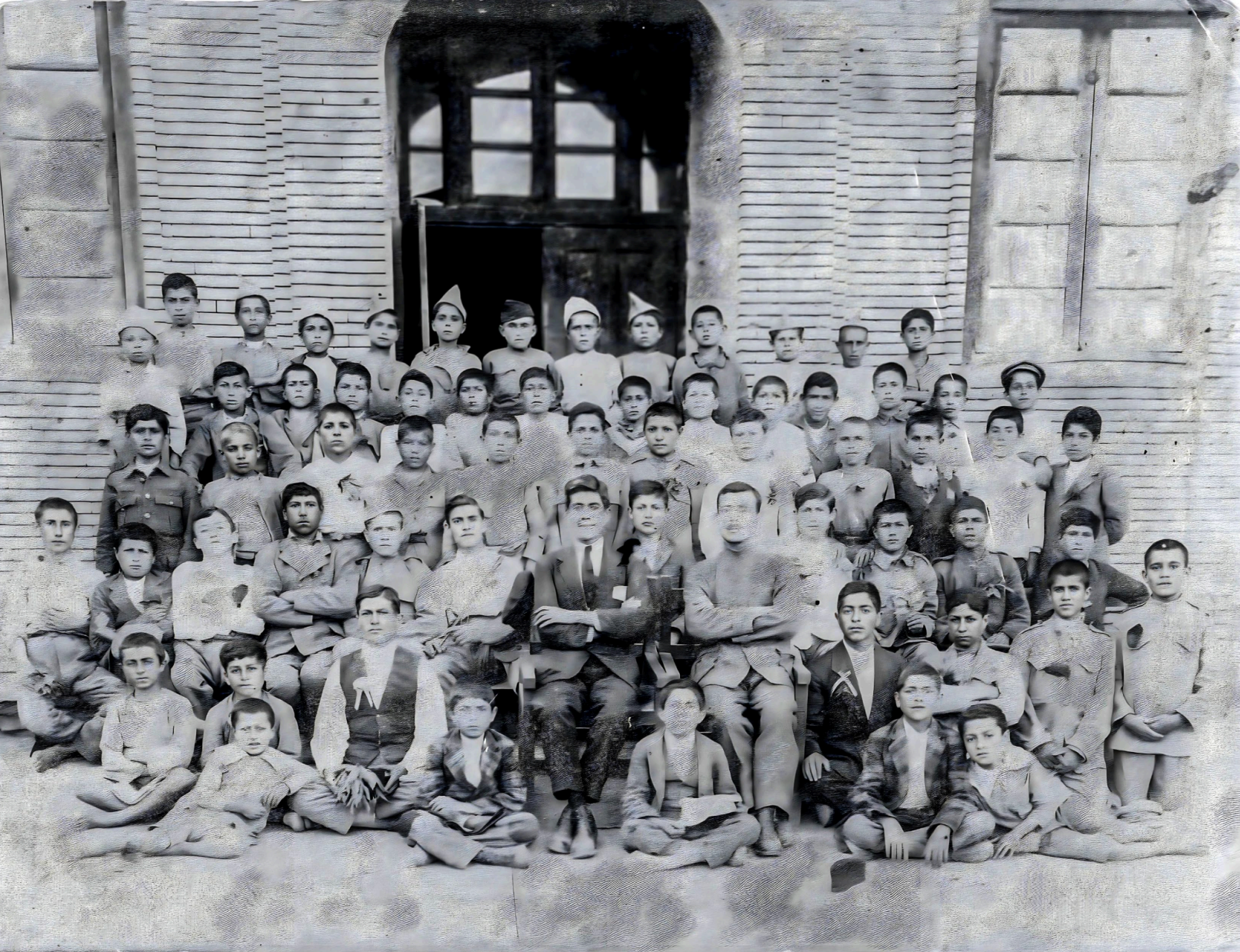
Mishael Shumon Enviya (in a suit seated in the center) as Math teacher and administrator at a boys school in Tabriz
(near Urmia), Iran, circa 1926-1927
Born and raised in the village of Golpashan, east of Urmia, my father, Mishael Shumon Enviya, was a published poet, a writer, and most of all, a voracious reader. His native language was vernacular Sureth (spoken by Assyrians), in which he put down his memoir poems, his sermons, and his letters. He also spoke the local Azeri Turkish dialect, which was the inter-ethnic urban language. His English, after having graduated at 20-years of age, from the American College for Males in Urmia (1835-1918), was accented but good. The college closed in 1918.
This phrase in Turkish was one he repeated when discussing his being a prisoner of war, captured by the Ottoman army that had invaded northwest Iran after the Russian army was ordered to return to revolutionary Russia by Lenin. The phrase says a lot about my father’s character:
“ Jojoghim, qorkhma.”
True, he was one of the lucky few who became an Ottoman POW yet survived the war. Just barely. His father, Shumon, did not. His sister, Almas, was traumatized all her life by having been abducted and forced into a rape camp for Turkish soldiers. His mother, Sarah, was an old lady of the old and wearied class who, for lack of servants, and near abject poverty, looked like seventy-years-old when she was still under fifty.
Recruited into the army of Agha Petros right after he graduated high school, my father had no military training when he was handed an old rifle and told to go to the river with a few other Assyrian men to guard the bridge into Urmia. He said he did not know how to shoot and was reprimanded by the officer for shooting into the air instead of at the enemy.
When the little Assyrian army was overrun by the Ottoman Turks, he took shelter at his paternal aunt’s house. She, being married to a leading Azeri (Muslim) member of the Beglerbegi family, hid him in her yard by lowering him into the well on a rope. But a servant informed the Ottoman army looking for Assyrians. He was dragged from the well and made a prisoner.
He was among many captured as the Ottomans entered Urmia. Most Assyrians had fled south toward the British lines following news of the assassination of Mar Benyamin Shimun, Catholicos Patriarch XXI of the Church of The East, by Simkho, the chief of the Shakkak Kurdish tribe in March 1918. The collapse of Assyrian forces meant that Assyrians and Armenians too headed south. That July, families packed what they could on carts pulled by female water buffalos (to provide milk) and started driving and walking toward Hamadan. That is if they had carts and drey animals left after their village homes were pillaged by Kurds and their animals stolen. They could not harvest their vineyards or fields. Grape harvest typically began after Sha’ara d’ Mart Maryam (Feast of St. Mary) commemorated on August 15. They packed flat bread, cheese, tea, a samovar and cups, molasses if some was still left from the year before, and raisins.
But my father could not do that. Instead at twenty years of age with his sister abducted and his mother’s whereabouts unknown, he became a starving Prisoner at the Turkish War Camp. I believe he was imprisoned for 3-6 months; we still don’t know the exact location of the camp.
He then heard a Turkish officer say to him “ Jojoghim, qorkhma.” He knew what that meant. He had enough Turkish Muslim cousins, through the marriage of his paternal aunt into one of the leading Muslim gentry families to understand the local Turkish language well. Perhaps he took heart at the kind words.
Eventually, together with three other captured Assyrian men, he stole away out of the camp. The war was ending, the Ottomans were defeated on the Western front in October 1918 and weakened considerably in the East despite the Russian withdrawal from the War; due in part to British alliances with Arab tribes. So the Assyrians fleeing that summer of 1918, saw their refuge in heading toward the British lines near modern day Iraq.
That is where my father and his three companions also headed. At least one died on the way, but my father made it to Hamadan, where the American missionaries had established schools and a rudimentary hospital.
Perhaps it was because my father had half-Muslim cousins, his captors treated him kindly. Perhaps it was because his path to becoming a pastor gave him time to reflect on the religious hatred that drove conflict. But when I think back to the emotion, and near tears in his eyes as he repeated what the Turkish officer said to him in the POW camp, I too become tearful.
“ Jojoghim, qorkhma” means “Little one, do not fear.”